

OT Cybersecurity in 2026: mass progress but adversaries still did better
OT security has evolved from a niche technical discipline into a strategic business priority. As industrial organizations continue connecting production environments with enterprise networks, cloud platforms, and remote access solutions, cyber risk has expanded alongside digital transformation. The findings of the State of Operational Technology and Cybersecurity Report 2026 reveal a clear trend: OT cybersecurity maturity is improving, but the threat landscape is becoming increasingly complex and demanding.
OT Security has reached the executive level
One of the strongest indicators of progress is the growing involvement of senior leadership. OT cybersecurity is no longer managed solely by plant engineers or operations teams. Security responsibility has increasingly moved into the C-suite, with 60% of organizations reporting that OT cybersecurity falls under the CISO or CIO. Furthermore, 81% of respondents who have not yet centralized responsibility plan to do so within the next year.
This shift reflects a broader understanding that cyber incidents can directly impact production, revenue, compliance, reputation, and even worker safety. Effective OT security now requires cooperation between operational teams, IT security professionals, and executive leadership.
A more honest assessment of security maturity
At first glance, the report appears to show a decline in cybersecurity maturity. Fewer organizations classified themselves at the highest maturity levels compared to previous years. However, this should not be viewed as a negative development.
As organizations deploy better monitoring tools and gain deeper visibility into their environments, hidden weaknesses become easier to identify. Rather than overestimating their capabilities, companies are now taking a more realistic view of their cybersecurity posture.
Key focus areas include:
- Asset visibility and discovery
- Network segmentation
- Access control improvement
- Security process standardization
- Enhanced monitoring and detection capabilities
Recognizing vulnerabilities is often the first step toward building a more resilient security program.
Better detection is driving higher incident reporting
The report highlights a significant increase in reported cyber intrusions. In 2026, 71% of respondents experienced between one and nine intrusion attempts or incidents, compared with 47% the previous year.
While this statistic may initially appear alarming, it likely indicates improved visibility rather than a dramatic rise in successful attacks. Organizations that implement stronger monitoring capabilities are naturally better equipped to identify malicious activity that may have previously gone unnoticed.
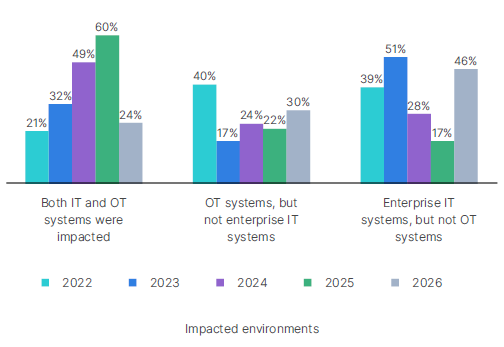
Encouragingly, only 24% of respondents reported intrusions affecting both IT and OT environments, a substantial decrease from 60% in 2025. This suggests that segmentation strategies are becoming more effective in limiting the spread of attacks.
Phishing and ransomware remain major threats
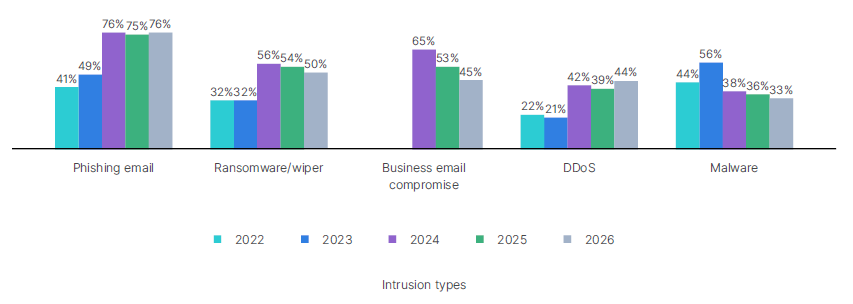
Despite advances in security programs, attackers continue relying on proven methods. Phishing remains the most common intrusion type, affecting 76% of surveyed organizations, while ransomware impacts 50%. DDoS attacks, compromised web applications, and business email compromise also continue to pose significant risks.
These findings demonstrate that many OT incidents still originate through traditional IT attack vectors. As industrial and enterprise environments become increasingly interconnected, organizations must address cybersecurity holistically rather than treating OT as a separate security domain.
Security awareness training, identity management, email protection, and Zero Trust principles remain critical elements of effective defense strategies.
Visibility continues to be a fundamental challenge
Asset visibility is one of the most important pillars of OT cybersecurity. Organizations cannot protect systems they cannot identify or monitor.
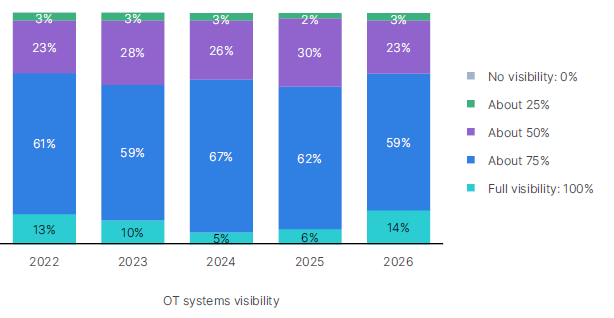
The report shows encouraging progress, with full OT visibility increasing from 5% in 2025 to 14% in 2026. However, nearly one-quarter of respondents still report visibility into only about half of their OT assets.
Limited visibility can create several challenges:
- Undiscovered vulnerable devices
- Poor understanding of network communications
- Delayed incident detection
- Incomplete asset inventories
- Difficulty implementing effective segmentation
Without comprehensive visibility, even well-funded security programs may struggle to identify and mitigate risk.
Longer attacker dwell times remain concerning
One of the more worrying findings involves attacker dwell time, which measures how long threat actors remain undetected inside an environment.
While shorter-duration incidents have remained relatively stable, attacks lasting weeks or even months have increased. Extended dwell times provide attackers with opportunities to conduct reconnaissance, steal sensitive information, establish persistence, and prepare disruptive attacks.
In industrial environments, where downtime and operational disruption can have serious financial and safety implications, reducing dwell time should remain a key objective for security teams.
Regulatory requirements are approaching quickly
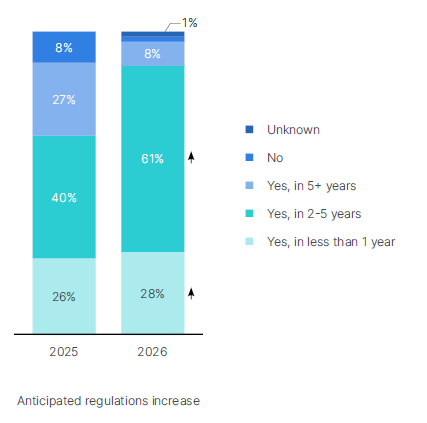
Organizations are also preparing for a rapidly changing regulatory landscape. According to the survey, 89% of respondents expect increased cybersecurity regulation within the next five years, compared with 66% in 2025.
Regulations are increasingly focusing on:
- Critical infrastructure protection
- Cyber resilience
- Incident reporting
- Risk management practices
- Supply chain security
Organizations that proactively strengthen governance and compliance processes today will be better positioned to address future requirements while simultaneously improving their overall security posture.
The road ahead
The report concludes that OT cybersecurity is progressing in the right direction. Organizations are improving governance, increasing visibility, modernizing ICS environments, and investing in more advanced security technologies. At the same time, cyber threats continue evolving, making security a continuous journey rather than a final destination.
To continue improving resilience, industrial organizations should prioritize:
- OT asset visibility
- IT/OT network segmentation
- Secure remote access
- OT-integrated incident response
- OT-specific threat intelligence
- Platform-based security architectures
The message from the 2026 findings is clear: OT cybersecurity maturity is increasing, but risk is not slowing down. Organizations that combine visibility, governance, operational awareness, and integrated security controls will be best positioned to protect their production environments and maintain business continuity in an increasingly connected world.

